Skip to content
Built Environment

A topic from several perspectives

Apply this topic to your work →

The Street

Explore the street through the perspectives below. Compare their examples and tradeoffs, then connect what you learn to your own work.

Illustrated study

A street holds more than movement

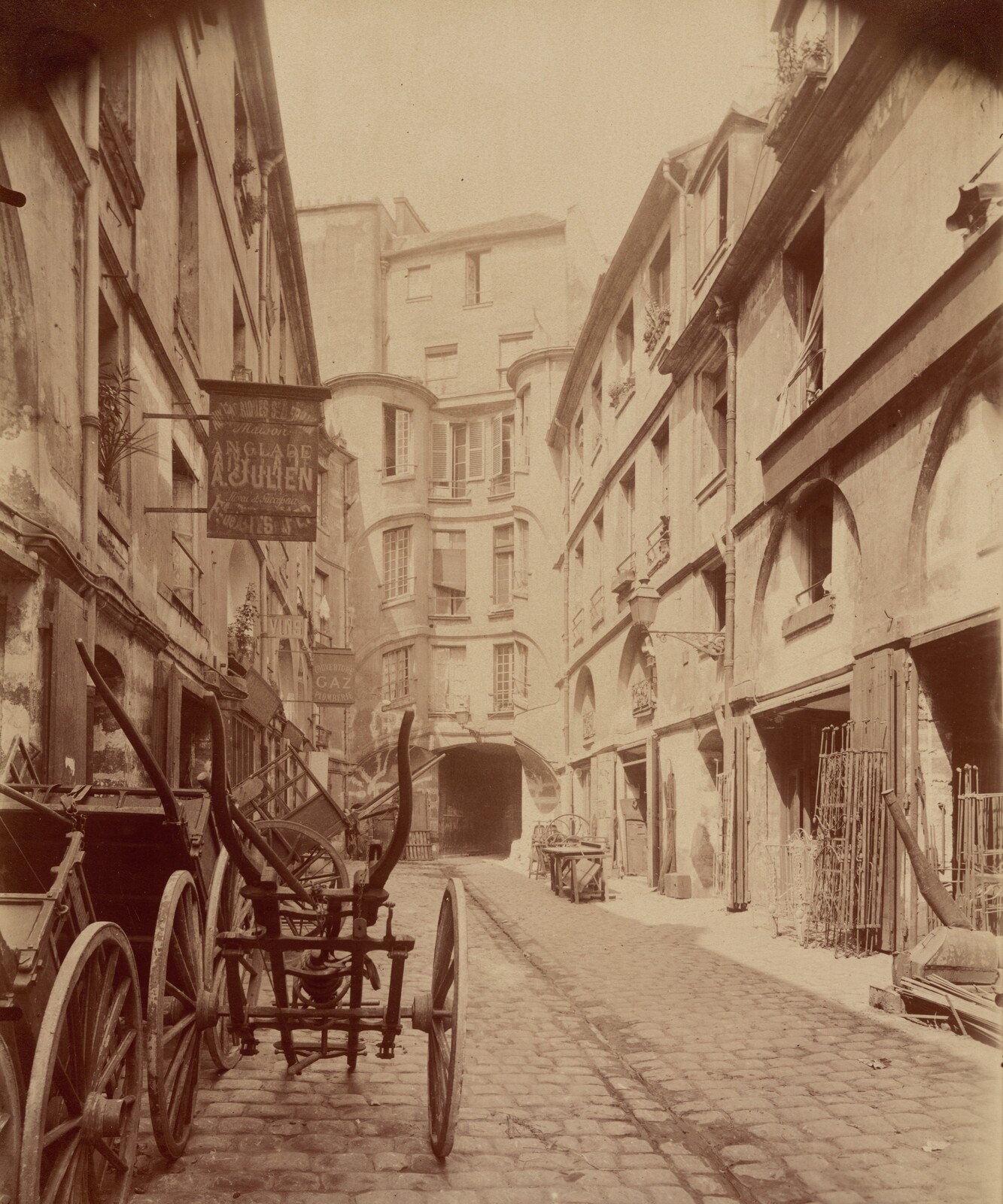
A Paris passage photographed in 1905 records the overlap between buildings, work and everyday circulation.

Sepia photograph of a cobbled Paris passage, with carts on the left, metalwork outside open premises on the right, hanging signs and an archway ahead.

Figure 1 · 1905

Cour du Dragon (Dragon Court)

Trace a route between the carts, doorways and objects beside the walls. Look upward to the signs, lamp and windows: several kinds of activity share this narrow space. On a street you know, what occupies the edges, and how does that affect where people can walk, stop or work?

Eugène Atget · National Gallery of Art, Washington
Gift of Stephen G. Stein · 2020.29.87

View full size ↗Download image
Collection record and reuse rights

Display copies are resized and compressed. Source and license links apply to the image above.

Explore more museum and archive collections →

Built Environment · The Street

Map an ordinary journey

Consider a street from the viewpoint of someone completing one everyday trip. Record transitions as well as destinations.

Try this

Sketch a short familiar route and note crossings, signs, waiting places and moments of uncertainty.

Reflect

How might the same route differ for someone with different mobility or sensory needs?

Take it further · optional follow-up

Choose one confusing transition and sketch an orientation cue. Describe what it might clarify and whose experience you would need to understand before evaluating it.

Compare with another activity · Hospitality

The Welcome: Write the next useful sentence →
Connect this activity with other subjects

Follow a question through three activities, with a worked example and a worksheet for your observations.

Prepared study prompt · not an editor-reviewed research article

Explore the perspectives

The eight prepared perspectives below are open to everyone. Sign in for expanded readings, a private notebook and collections.

Sign in for a deeper reading and notebook →

Material

What is it made of, and why does that matter?

A street consists of more than pavement: curbs, drainage, planting, lighting, signs and building edges shape its use. Materials must accommodate wear, weather and maintenance.

Historical

How did this evolve, and why has it endured?

Street forms evolved with walking, trade, carts, transit and automobiles. A historical photograph records one moment; maps and planning records can show how routes and activities changed.

Human

How do people actually experience this?

A street is experienced differently by a pedestrian, wheelchair user, cyclist, driver or someone waiting for a bus. Crossings, resting places and legible entrances shape access and confidence. Follow a journey from a bus stop to a shop entrance. The important obstacles may occur between designed elements: a sign in a walking route, a difficult crossing or nowhere to pause. Study the connected journey rather than assessing each feature in isolation.

Ecological

How does it meet the living world?

Street trees, permeable surfaces and drainage systems affect heat and stormwater. Their benefits depend on local climate, soils, upkeep and how much space is allocated to each use.

Cultural

How have different societies approached this?

Streets host commerce, gathering, celebration and conflict. Their design expresses decisions about whose movement and activities take priority. The same street may support deliveries in the morning, shopping during the day and gatherings later. A design that serves one activity can constrain another. Ask whose routines shaped the plan and which uses are accommodated through informal adjustment.

Technical

How does it actually work?

Plans and sections reveal lane widths, gradients, utilities and crossings. Observation adds evidence about behavior, but compliance and safety require measurements and applicable standards.

Aesthetic

What makes it beautiful, meaningful, or enduring?

A street's visual character comes from rhythm, building fronts, trees, signs and changing views. Study what happens at eye level as carefully as the skyline.

Lessons & Failures

What has humanity learned the hard way?

Confusing crossings, obstructed sidewalks, poor drainage and excessive speeds can make a street difficult to use. A visually attractive streetscape may still fail people with different mobility needs.