Skip to content
Medicine

A topic from several perspectives

Apply this topic to your work →

The Waiting Room

Explore the waiting room through the perspectives below. Compare their examples and tradeoffs, then connect what you learn to your own work.

Illustrated study

The space before an encounter

A historical photograph gives us a particular arrangement of seats, people and shared space to examine.

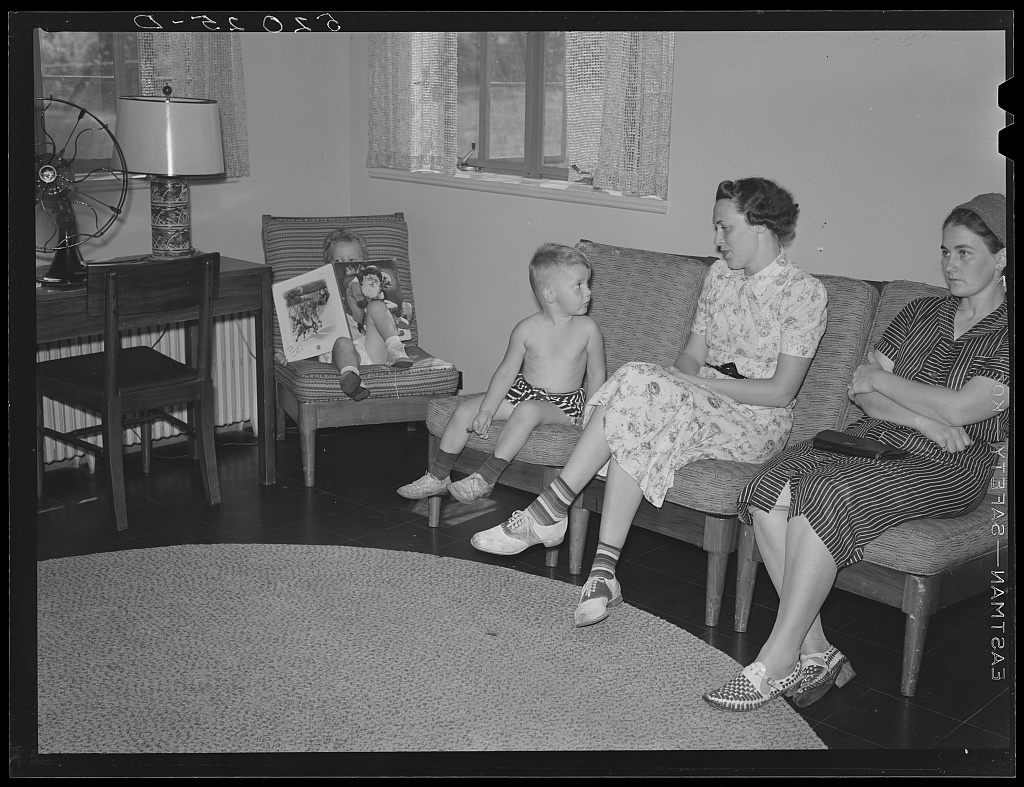
Black-and-white photograph of adults and children seated around a low table in a room with windows and curtains.

Figure 1 · August 1939

Untitled photograph, possibly a medical-center waiting room, Greenbelt, Maryland

Look at the relationship between the seats, shared table and windows. What opportunities for conversation or separation does the arrangement suggest? The archive identifies the setting tentatively; the image arrived untitled. It cannot tell us how long anyone waited or what they felt.

Marion Post Wolcott · Library of Congress
FSA/OWI collection · LC-USF34-052025-D · No known restrictions

View full size ↗Download image
Collection record and reuse rights

Display copies are resized and compressed. Source and license links apply to the image above.

Explore more museum and archive collections →

Medicine · The Waiting Room

Trace the moments before care

The waiting room connects the public entrance to a more private encounter. Seating, reception, signs and announcements help organize that transition, while visitors bring different expectations and needs. Use the historical photograph as a record of one arrangement; its tentative catalogue title should remain visible in your account.

Try this

Draw a fictional waiting-room route from entrance to reception, seat and consultation door. At each point write one question a newcomer might have. Use an imagined plan rather than photographing patients or recording conversations.

Reflect

Which uncertainty could be resolved by clearer information, and which would require a change in the service itself?

Take it further · optional follow-up

Ask a reader to follow your fictional arrival plan using only its signs. Note what they have to infer, then revise one instruction or decision point.

Compare with another activity · Hospitality

The Welcome: Write the next useful sentence →
Connect this activity with other subjects

Follow a question through three activities, with a worked example and a worksheet for your observations.

Prepared study prompt · not an editor-reviewed research article

Explore the perspectives

The eight prepared perspectives below are open to everyone. Sign in for expanded readings, a private notebook and collections.

Sign in for a deeper reading and notebook →

Historical

How did this evolve, and why has it endured?

A waiting room records how an institution organizes the period before an encounter. The 1939 photograph catalogued by the Library of Congress provides one historical scene, with an explicitly tentative location description. Compare the seating, table and windows with a present-day plan. Neither image can explain the appointment system or the people’s experiences on its own.

Human

How do people actually experience this?

Imagine arriving without knowing whether to check in, sit down or listen for a name. A useful arrival sequence answers each question at the point it arises. Consider a person accompanying someone else as well as a person arriving alone. Familiar routines for staff may be unfamiliar to visitors, particularly when attention is occupied by worry.

Ethical

What responsibilities does this practice carry?

Waiting makes people visible to one another while they may be dealing with private matters. Consider where a conversation at reception can be overheard and whether someone can ask a question discreetly. A welcoming design needs to account for privacy and choice alongside efficient movement. A photograph cannot tell us whether people felt respected.

Cultural

How have different societies approached this?

Instructions may assume a shared language or familiarity with an institution. A numbered ticket, spoken name and electronic display each ask people to recognize a different convention. Compare the information each provides and what happens if it is missed. Ask visitors about their preferences rather than using background or appearance to predict them.

Technical

How does it actually work?

Map the sequence of arrival, check-in, waiting and invitation onward. Identify the information passed at each transition and who can resolve uncertainty. For example, a display may announce a destination while leaving unclear how to reach it. The room's furniture and the service's communication process need to be considered together.

Debates

Where do thoughtful practitioners disagree?

Compare two imagined arrangements: waiting together in a visible shared space, or waiting elsewhere and receiving a message. Each raises questions about access to staff, reliable contact and the ability to use a phone. Evaluate the options with the people who would use them; moving a queue out of sight does not demonstrate a shorter wait.

Economic

How has commerce shaped this?

Time spent waiting may interact with paid work, transport, childcare and support from others. Staff also need time to explain delays and respond to questions. List these different demands before describing an arrangement as efficient. A room that accommodates more seats does not necessarily resolve the reason people are waiting.

Ecological

How does it meet the living world?

Study daylight, sound, temperature, furnishings and the work of maintaining the room. A bright window may offer a view while creating glare at a particular seat. Record the time and position of an observation before generalizing. Claims about air quality or infection prevention require appropriate assessment, not an impression of spaciousness or cleanliness.