Skip to content
Medicine

A topic from several perspectives

Apply this topic to your work →

The Pulse

Explore the pulse through the perspectives below. Compare their examples and tradeoffs, then connect what you learn to your own work.

Illustrated study

A gesture of examination

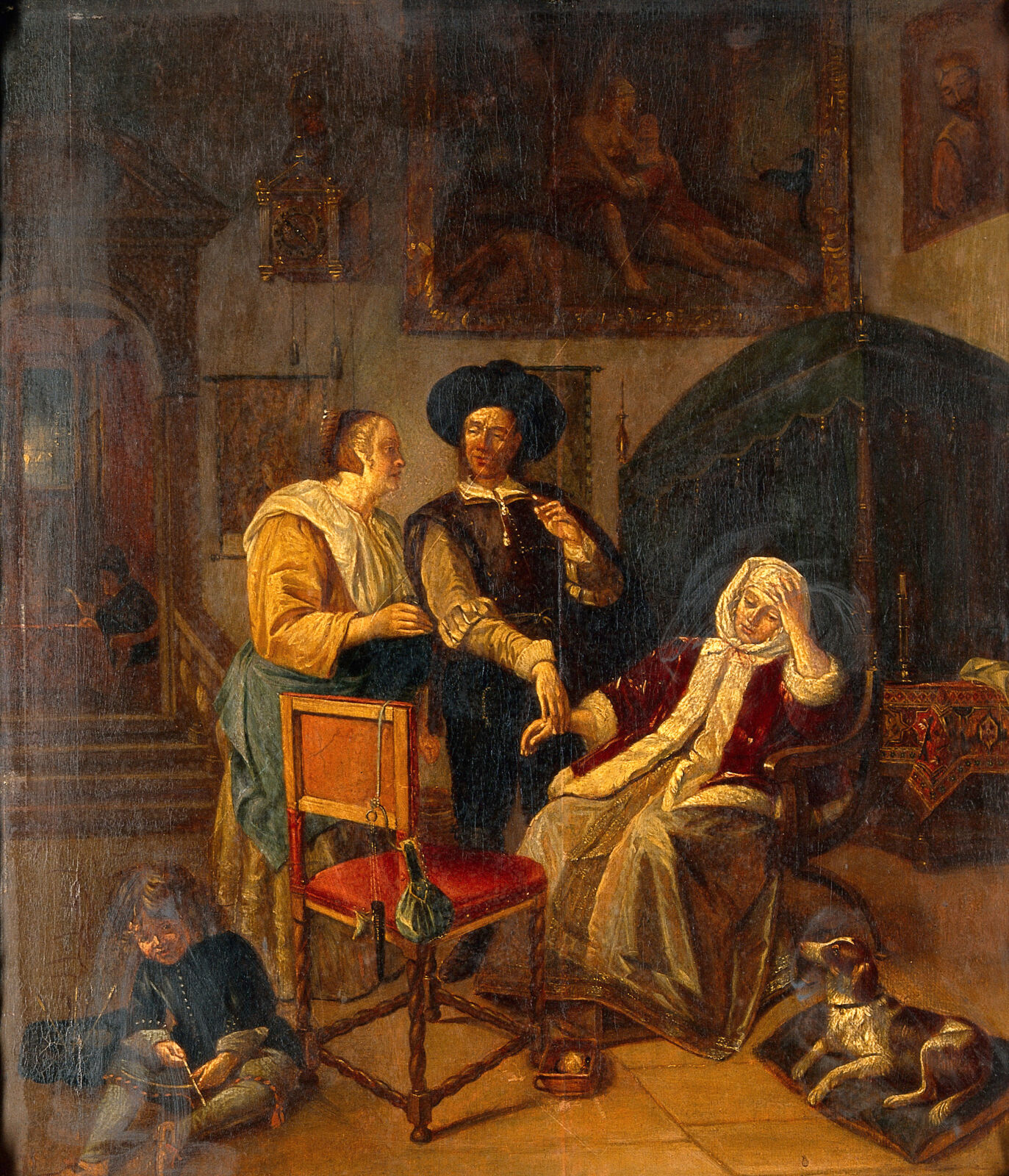
A historical painting after Jan Steen shows pulse-taking within a crowded domestic scene.

Oil painting of a physician touching the wrist of a seated woman while another woman stands nearby, with a child, dog and household furnishings in the room.

Figure 1 · Date unrecorded

A physician taking the pulse

Find the contact between the physician’s hand and the seated woman’s wrist, then notice where the figures direct their attention. This is a painted scene, not a clinical record, so it cannot tell us what was measured or diagnosed. What does the image reveal about the setting of care, and what questions remain beyond its frame?

Artist unrecorded, after Jan Steen · Wellcome Collection
Wellcome Collection · 44729i · V0017281

View full size ↗Download image
Collection record and reuse rights

Display copies are resized and compressed. Source and license links apply to the image above.

Explore more museum and archive collections →

Medicine · The Pulse

Examine the language of measurement

Use a public educational explanation of pulse to study how a measurement is described. This exercise does not ask you to measure or interpret anyone's health.

Try this

Identify what the explanation says is measured, what context it requires and which conclusions it does not support.

Reflect

Where might a reader confuse a number with a diagnosis?

Take it further · optional follow-up

Rewrite the public explanation for a general reader while retaining its stated limits. Mark any phrase whose meaning you would need to verify with the original source.

Compare with another activity · Education

The Textbook: Read the structure of a lesson →

Prepared study prompt · not an editor-reviewed research article

Explore the perspectives

The eight prepared perspectives below are open to everyone. Sign in for expanded readings, a private notebook and collections.

Sign in for a deeper reading and notebook →

Historical

How did this evolve, and why has it endured?

Pulse examination has a long history in different medical traditions. Its interpretation changed as timekeeping, anatomy and cardiovascular physiology developed. Historical descriptions should be understood in their own contexts rather than treated as interchangeable with contemporary measurements.

Human

How do people actually experience this?

Measuring a pulse is a moment of contact between clinician and patient. Anxiety, activity, position and other circumstances can affect a reading, while communication helps explain why the measurement is being taken.

Ethical

What responsibilities does this practice carry?

A pulse value is sensitive health information when associated with an individual. Consent, privacy and appropriate interpretation matter. A single number should not be used to make unsupported conclusions about a person's condition.

Cultural

How have different societies approached this?

Traditions of pulse examination have developed distinct concepts and techniques. Compare their historical language carefully; a shared word does not mean that different systems measure or interpret exactly the same thing.

Technical

How does it actually work?

Heart rate is the number of heartbeats per minute, while a palpated peripheral pulse reflects pressure waves traveling through arteries. Rhythm, rate and pulse quality are related but different observations. Clinical interpretation requires context and trained judgment.

Debates

Where do thoughtful practitioners disagree?

Consumer wearables can estimate heart rate continuously, but accuracy varies with device, movement and conditions. Discuss what validation evidence is needed before using a measurement for a particular purpose.

Economic

How has commerce shaped this?

Affordable instruments have widened access to physiological measurements. More measurements can also create costs through interpretation, follow-up and false alarms. Assess benefit in the context of the intended use.

Ecological

How does it meet the living world?

A person's cardiovascular responses occur within environments of heat, exertion, altitude and stress. Environmental conditions can change observations; this does not make an isolated pulse measurement a reliable diagnosis.