Skip to content
Conservation

A topic from several perspectives

Apply this topic to your work →

The Archive

Explore the archive through the perspectives below. Compare their examples and tradeoffs, then connect what you learn to your own work.

Illustrated study

Preserving a thought in progress

An original notebook page keeps the marks and arrangement of an idea as it was being worked out.

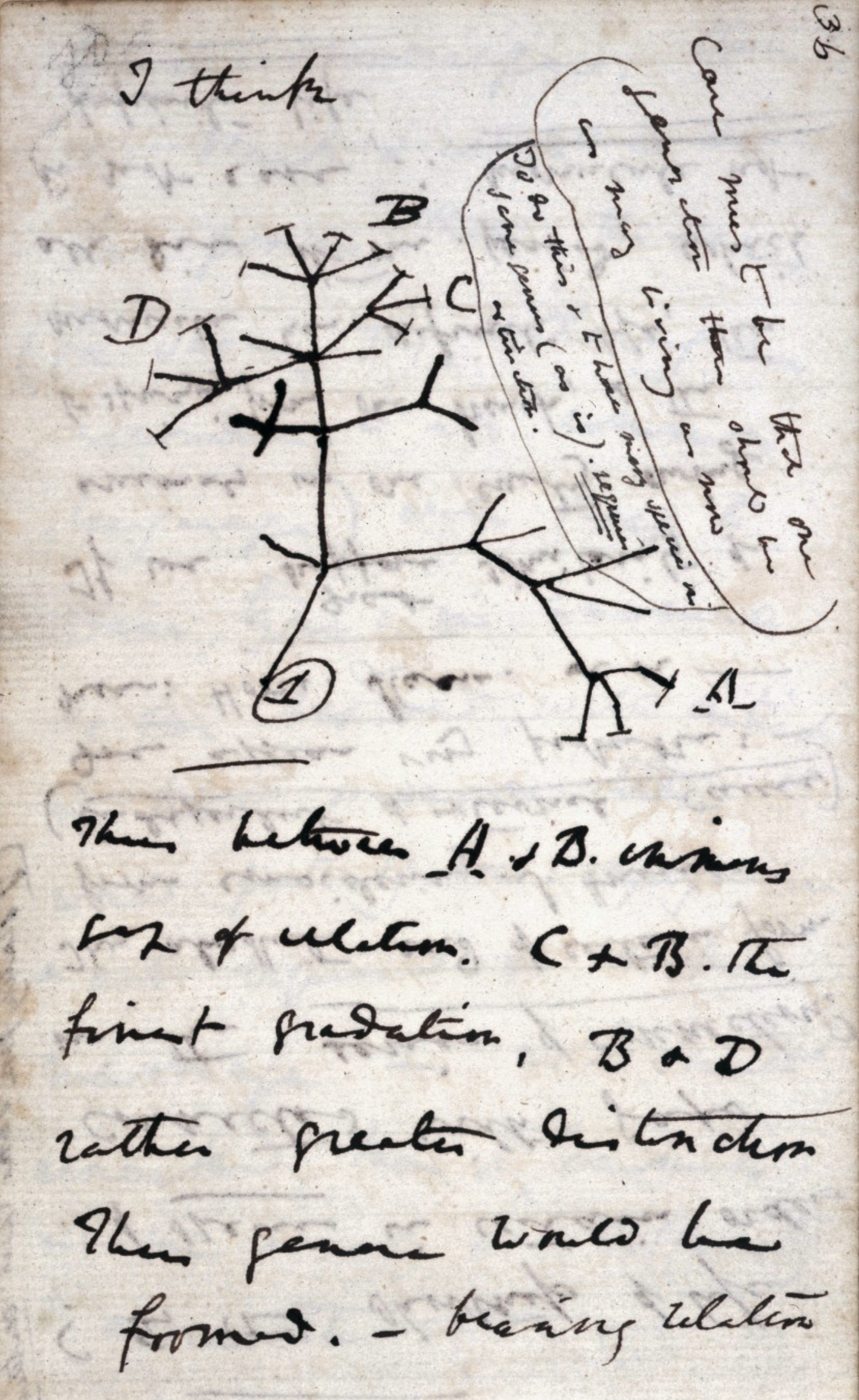
A handwritten notebook page headed I think, with a branching diagram labeled A, B, C and D, and notes written beside and below the sketch.

Figure 1 · 1837

Branching sketch in Notebook B, page 36

Notice the words ‘I think,’ the branching lines and the writing fitted around them. The page preserves an act of reasoning as well as an idea about relationships among species. What would disappear if only a clean redrawing survived? When keeping a record, preserve enough context for someone else to understand where it came from.

Charles Darwin · Darwin Online · reproduction via Wikimedia Commons
Notebook B: Transmutation of species (1837–1838) · page 36

View full size ↗Download image
Collection record and reuse rights

Display copies are resized and compressed. Source and license links apply to the image above.

Explore more museum and archive collections →

Conservation · The Archive

Describe how something can be found

Imagine giving another person access to a small fictional collection. Study the description needed to locate an item and understand its context.

Try this

Create five sample catalog entries with consistent fields. Keep unknown creator or date information explicitly unknown.

Reflect

Which context would be lost if the item were separated from its record?

Take it further · optional follow-up

Try retrieving a fictional item by its subject instead of its title. Add a descriptive field where needed while keeping unknown facts explicitly unknown.

Compare with another activity · Property & Renewal

The Handover: Design a useful record →
Connect this activity with other subjects

Follow a question through three activities, with a worked example and a worksheet for your observations.

Prepared study prompt · not an editor-reviewed research article

Explore the perspectives

The eight prepared perspectives below are open to everyone. Sign in for expanded readings, a private notebook and collections.

Sign in for a deeper reading and notebook →

Historical

How did this evolve, and why has it endured?

Archives preserve records created for different purposes and audiences. Their organization changes over time, so the way a collection is catalogued can shape what later researchers find.

Ecological

How does it meet the living world?

Paper, film and digital media each require suitable storage conditions and resources. Preservation planning considers humidity, light, energy and the risks of material deterioration.

Ethical

What responsibilities does this practice carry?

Archives must balance access with privacy, cultural responsibilities and the wishes of people represented in records. Possessing a document does not automatically grant permission to publish it.

Material

What is it made of, and why does that matter?

Ink, paper, bindings, photographs and digital storage all age differently. Preservation begins by identifying the medium and its condition before choosing treatment or migration.

Cultural

How have different societies approached this?

A collection reflects decisions about whose experiences were recorded and valued. Gaps in an archive can be as important to acknowledge as the surviving material.

An archive of official correspondence may record decisions in detail while preserving little of the people affected by them. The absence of their words does not establish an absence of experience or disagreement. Describe the collection's scope and seek complementary records when building an account.

Human

How do people actually experience this?

A useful archive lets someone understand who made a record, why it exists and how it relates to other records. Clear descriptions support future readers without pretending every uncertainty is resolved.

A letter detached from its envelope may lose evidence about its recipient or date. A digital scan detached from its catalogue record can lose similar context. Keep relationships between items visible so a future reader can understand what is known and where an attribution came from.

Debates

Where do thoughtful practitioners disagree?

Digitization expands access but cannot capture every physical quality or context of an original. Conservation choices also weigh access, resources and the risk of intervention.

Future

Where might this be heading?

Sustainable archives need formats, documentation and stewardship that can outlast current software. Migration plans and provenance records are as important as storing copies.