Skip to content
Property & Renewal

A topic from several perspectives

Apply this topic to your work →

The Building Survey

Explore the building survey through the perspectives below. Compare their examples and tradeoffs, then connect what you learn to your own work.

Illustrated study

A building translated into a record

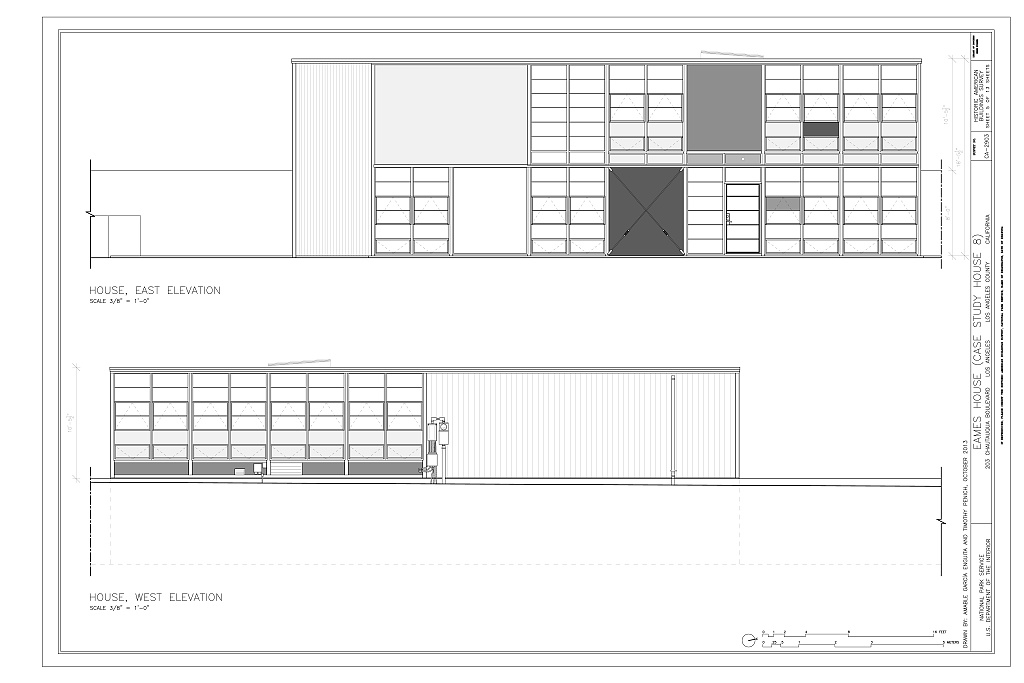
An Eames House survey elevation shows what a measured drawing can isolate from a complex site.

Measured architectural sheet documenting the east and west elevations of the Eames House.

Figure 1 · 2013

Eames House: east and west elevations

Read the dimensions, openings and repeated elements. What can this elevation communicate precisely, and what would still require photographs, condition notes or a visit? A measured drawing records geometry; it is not by itself a diagnosis of the building's condition.

Amable Garcia Enguita · Historic American Buildings Survey · Library of Congress · HABS CA-2903
HABS CA-2903, sheet 5 of 13 · Library of Congress

View full size ↗Download image
Collection record and reuse rights

Display copies are resized and compressed. Source and license links apply to the image above.

Explore more museum and archive collections →

Property & Renewal · The Building Survey

Write the questions before the conclusions

A visible condition note is a starting point for questions, not a structural assessment. Practice describing uncertainty precisely.

Try this

Choose a photograph or safely visible detail. Make separate lists of observations, possible explanations and specialist questions.

Reflect

Which unknown would most affect a decision to proceed?

Take it further · optional follow-up

Rank your unanswered questions by how much their answers could change the proposed work. Identify the appropriate kind of record or qualified assessment for the first question.

Compare with another activity · Manufacturing

The Prototype: Choose what to learn →
Connect this activity with other subjects

Follow a question through three activities, with a worked example and a worksheet for your observations.

  • Work with uncertainty →

    Make assumptions and missing information visible before proposing an answer.

    This topic is activity 1 of 3.

Prepared study prompt · not an editor-reviewed research article

Explore the perspectives

The eight prepared perspectives below are open to everyone. Sign in for expanded readings, a private notebook and collections.

Sign in for a deeper reading and notebook →

Material

What is it made of, and why does that matter?

A survey begins by identifying visible materials and their condition. Similar-looking finishes can conceal different substrates, repairs and moisture behavior.

Technical

How does it actually work?

A building survey records observations and limitations, then recommends further investigation where necessary. Visual inspection alone cannot establish concealed structural or electrical conditions.

A stain is an observation; an active leak is one possible explanation. A useful report records the stain's location, the conditions of inspection and what was inaccessible, then identifies the further assessment needed. This separation helps the reader understand what the survey establishes and what remains a question.

Economic

How has commerce shaped this?

Early condition information helps prioritize expenditure and contingencies. A survey reduces some uncertainty but cannot guarantee that every defect has been found.

Ethical

What responsibilities does this practice carry?

Clear reporting distinguishes observed facts, suspected causes and uninspected areas. Overstating certainty can mislead owners and future occupants.

Human

How do people actually experience this?

Owners, tenants and tradespeople may know how a building behaves through seasons and use. Their accounts can guide questions while remaining distinct from verified findings.

An occupant may report that a room becomes damp only after rain from one direction. That account can make a later inspection more focused, even if the symptom is absent on the inspection day. Record who observed it, when it occurred and what they actually noticed without turning the account into a confirmed diagnosis.

Historical

How did this evolve, and why has it endured?

Older buildings reflect successive materials, regulations and alterations. Understanding construction period helps frame questions without treating age as a diagnosis.

Ecological

How does it meet the living world?

Repairing an existing building can conserve resources, but moisture, ventilation and energy upgrades require whole-building thinking.

Lessons & Failures

What has humanity learned the hard way?

Concealed defects, inaccessible areas and incomplete records are common limitations. A useful survey makes these limits visible rather than implying complete certainty.