Skip to content
Manufacturing

A topic from several perspectives

Apply this topic to your work →

Tolerance

Explore tolerance through the perspectives below. Compare their examples and tradeoffs, then connect what you learn to your own work.

Illustrated study

From a dimension to a fit

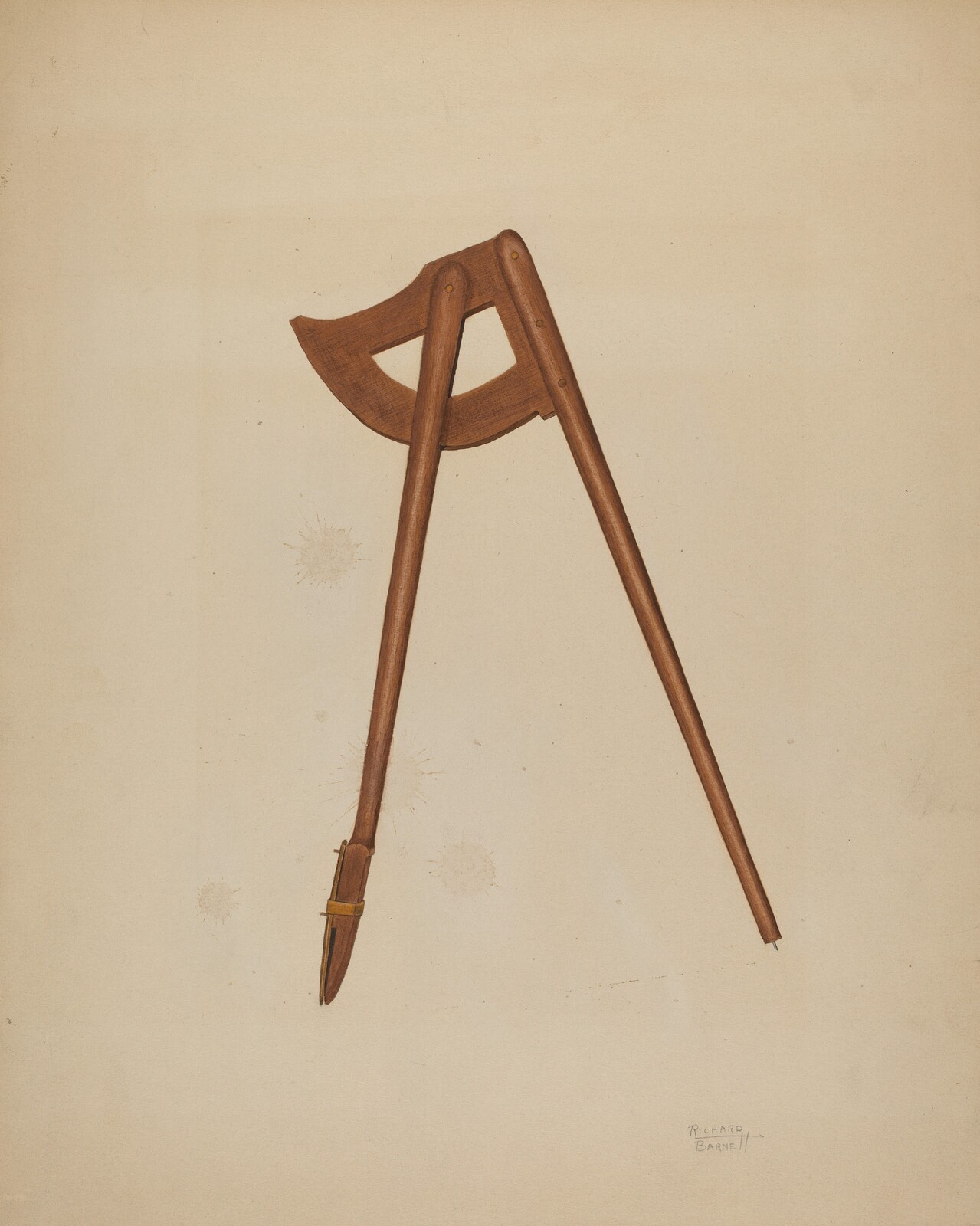
A drawing of a Shaker compass introduces the practical work of setting out and comparing dimensions.

Watercolor and graphite drawing of a large wooden compass with two long legs, a curved adjustment piece and pointed ends.

Figure 1 · c. 1938

Shaker Compass

Look at the opening between the two tips and the parts that hold that opening. A compass can carry a dimension from one place to another; this drawing does not tell us its precision. Tolerance asks a further question: how much variation can the finished work allow? Compare the fit needed for a drawer to slide with the fit needed for a joint to stay firm.

Richard Barnett · National Gallery of Art, Washington
Index of American Design · 1943.8.13679

View full size ↗Download image
Collection record and reuse rights

Display copies are resized and compressed. Source and license links apply to the image above.

Explore more museum and archive collections →

Manufacturing · Tolerance

Define acceptable variation

Use a paper model to distinguish an intended dimension from an acceptable range. The range needs a purpose, not just a number.

Try this

Invent two pieces that must fit together and describe what too loose or too tight would mean for their use.

Reflect

Which requirement determines the acceptable variation?

Take it further · optional follow-up

Change the intended use of your paper pieces. Reconsider which variation matters and explain why the original acceptance range may no longer fit.

Compare with another activity · Graphic Design

Kerning: Study the space between a pair →
Connect this activity with other subjects

Follow a question through three activities, with a worked example and a worksheet for your observations.

Prepared study prompt · not an editor-reviewed research article

Explore the perspectives

The eight prepared perspectives below are open to everyone. Sign in for expanded readings, a private notebook and collections.

Sign in for a deeper reading and notebook →

Material

What is it made of, and why does that matter?

Every manufactured material varies with temperature, moisture, processing and measurement. Tolerances describe acceptable variation for a particular function, not an abstract standard of perfection.

Technical

How does it actually work?

A nominal dimension and its permitted range must be tied to how parts fit and work together. Measurement uncertainty and the accumulation of variation across assemblies also matter.

Economic

How has commerce shaped this?

Tighter tolerances can require slower processing, inspection or rejected parts. The appropriate range balances function, reliability and the cost of achieving it.

Consider a visible decorative edge and a mating surface hidden inside an assembly. They may need different degrees of dimensional control because they perform different jobs. Specifying the same precision everywhere can spend effort where it contributes little to the product's purpose.

Historical

How did this evolve, and why has it endured?

Interchangeable-part production encouraged systematic dimensional standards and gauges. The development of metrology made variation easier to describe and control.

Human

How do people actually experience this?

Inspectors, machinists and designers may interpret a drawing differently unless its requirements are clear. Good documentation allows people to identify ambiguity before work is repeated.

A drawing that says a part must fit is not yet a shared definition of acceptance. The designer, maker and inspector need to agree which surfaces matter and how the result will be judged. Resolving that ambiguity before production prevents repeated disagreement over otherwise careful work.

Ecological

How does it meet the living world?

Unnecessarily strict requirements can increase scrap and energy use. A functional tolerance may conserve resources without compromising performance.

Ethical

What responsibilities does this practice carry?

Dimensional requirements are especially consequential in safety-critical products. Claims of compliance require appropriate testing and traceable records.

Debates

Where do thoughtful practitioners disagree?

Statistical process control, selective assembly and precision machining offer different ways to manage variation. No method is best independently of the product and its consequences of failure.