Skip to content
Manufacturing

A topic from several perspectives

Apply this topic to your work →

The Mold

Explore the mold through the perspectives below. Compare their examples and tradeoffs, then connect what you learn to your own work.

Illustrated study

The shape before the object

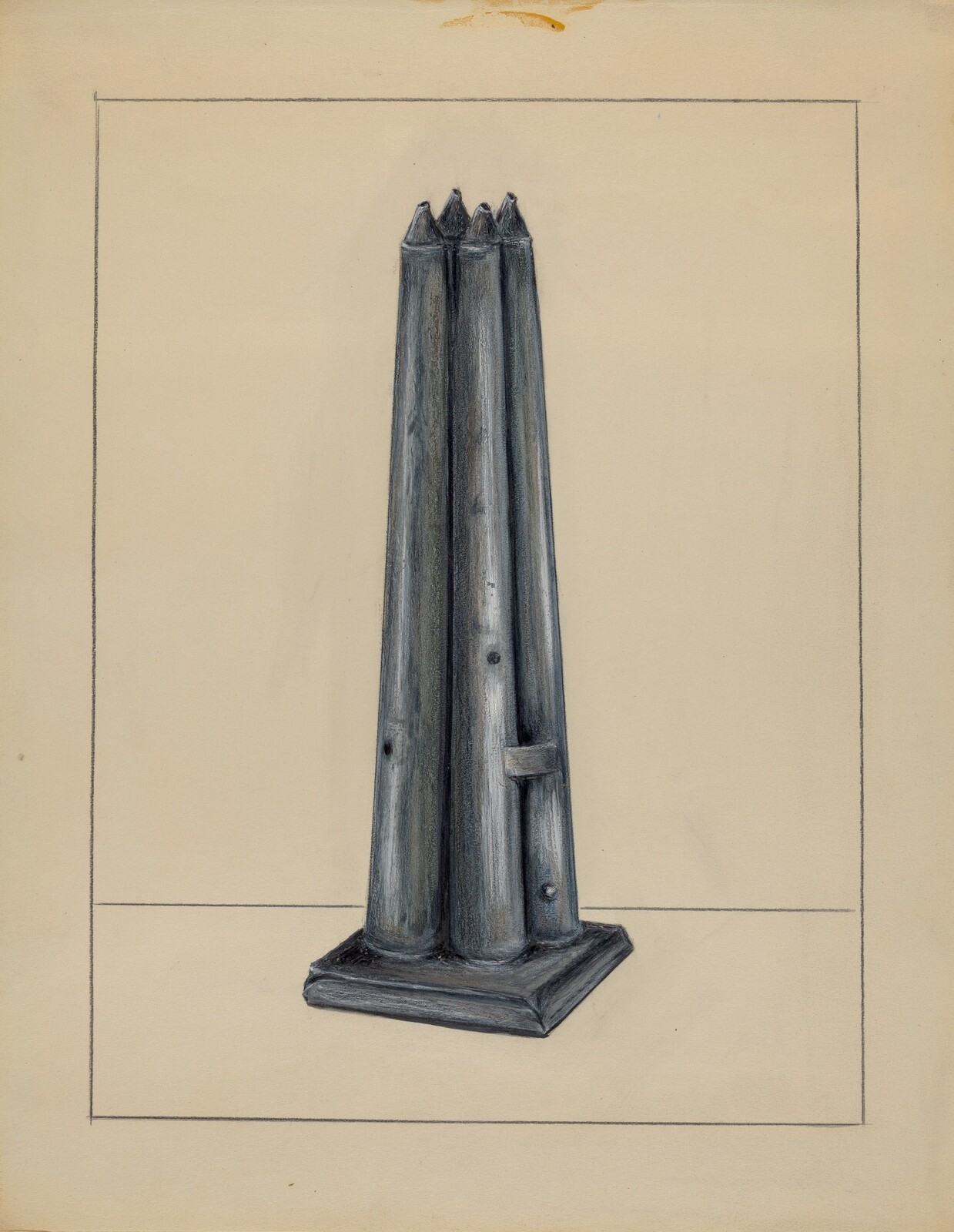
A carefully drawn candle mold makes repeated form visible through the tool that produces it.

Watercolor and graphite study of a metal candle mold with long parallel tubes, tapered tips, connecting pieces and a rectangular base on cream paper.

Figure 1 · c. 1936

Candle Mold

Compare the repeated tubes and their tapered ends. The drawing records the outside of a tool; the space inside is what gives the finished object its form. What can you infer from this view, and what would require another view or a demonstration? Look for another everyday object whose shape suggests the mold it came from.

Holger Hansen · National Gallery of Art, Washington
Index of American Design · 1943.8.12679

View full size ↗Download image
Collection record and reuse rights

Display copies are resized and compressed. Source and license links apply to the image above.

Explore more museum and archive collections →

Manufacturing · The Mold

Look for the making question

Study a photograph of a molded everyday object. Visible features can suggest questions about manufacture without proving the process.

Try this

Mark repeated shapes, seams and surface changes. Label any proposed manufacturing explanation as a hypothesis.

Reflect

What production information would distinguish between your explanations?

Take it further · optional follow-up

Write two possible explanations for one visible seam. Identify the production record or maker's account that could distinguish them.

Compare with another activity · Built Environment

Brick: Look at the joint as well as the unit →

Prepared study prompt · not an editor-reviewed research article

Explore the perspectives

The eight prepared perspectives below are open to everyone. Sign in for expanded readings, a private notebook and collections.

Sign in for a deeper reading and notebook →

Material

What is it made of, and why does that matter?

A mold gives shape to material as it solidifies, cures or is formed. Mold materials must tolerate the process temperature, pressure and number of repetitions expected.

Technical

How does it actually work?

Parting lines, draft angles, vents and shrinkage affect the finished form. A seam visible on an object can suggest a molding process, but confirming the method requires manufacturing evidence.

Economic

How has commerce shaped this?

A costly mold may be economical across many units, while a simpler tool can suit short runs. Tool life, setup and defect rates matter alongside the price of each part.

Imagine a short run of a container whose shape is still changing. A durable production tool may be premature if another revision would make it obsolete. Compare the cost of learning with a simpler model against the commitment involved in final tooling.

Historical

How did this evolve, and why has it endured?

Molds have been used for ceramics, metal and other materials for millennia. Industrial molding later expanded the range and volume of repeatable products.

Human

How do people actually experience this?

Mold makers rely on spatial reasoning, materials knowledge and careful adjustment. Their expertise can be difficult to infer from the apparently identical objects a process produces.

A finished object hides much of the work that made repetition possible. Compare a trial piece with a revised one and ask which surface or junction changed. A maker's explanation can connect the visible difference to a decision that the object alone would not reveal.

Ecological

How does it meet the living world?

Tooling enables repetition but also consumes materials and energy. Reusable molds, scrap rates, material selection and end-of-life recovery affect overall impact.

Ethical

What responsibilities does this practice carry?

Safe handling of heat, pressure, fumes and moving equipment requires trained practice and appropriate controls. This study examines principles rather than giving equipment-operating instructions.

Debates

Where do thoughtful practitioners disagree?

Additive manufacturing can reduce the need for some tooling, while traditional molding remains effective for many materials and production volumes. Compare total process requirements rather than one headline cost.