Skip to content
Education

A topic from several perspectives

Apply this topic to your work →

The Blackboard

Explore the blackboard through the perspectives below. Compare their examples and tradeoffs, then connect what you learn to your own work.

Illustrated study

Making an idea visible

A watercolor brings teaching, drawing and shared attention into one frame.

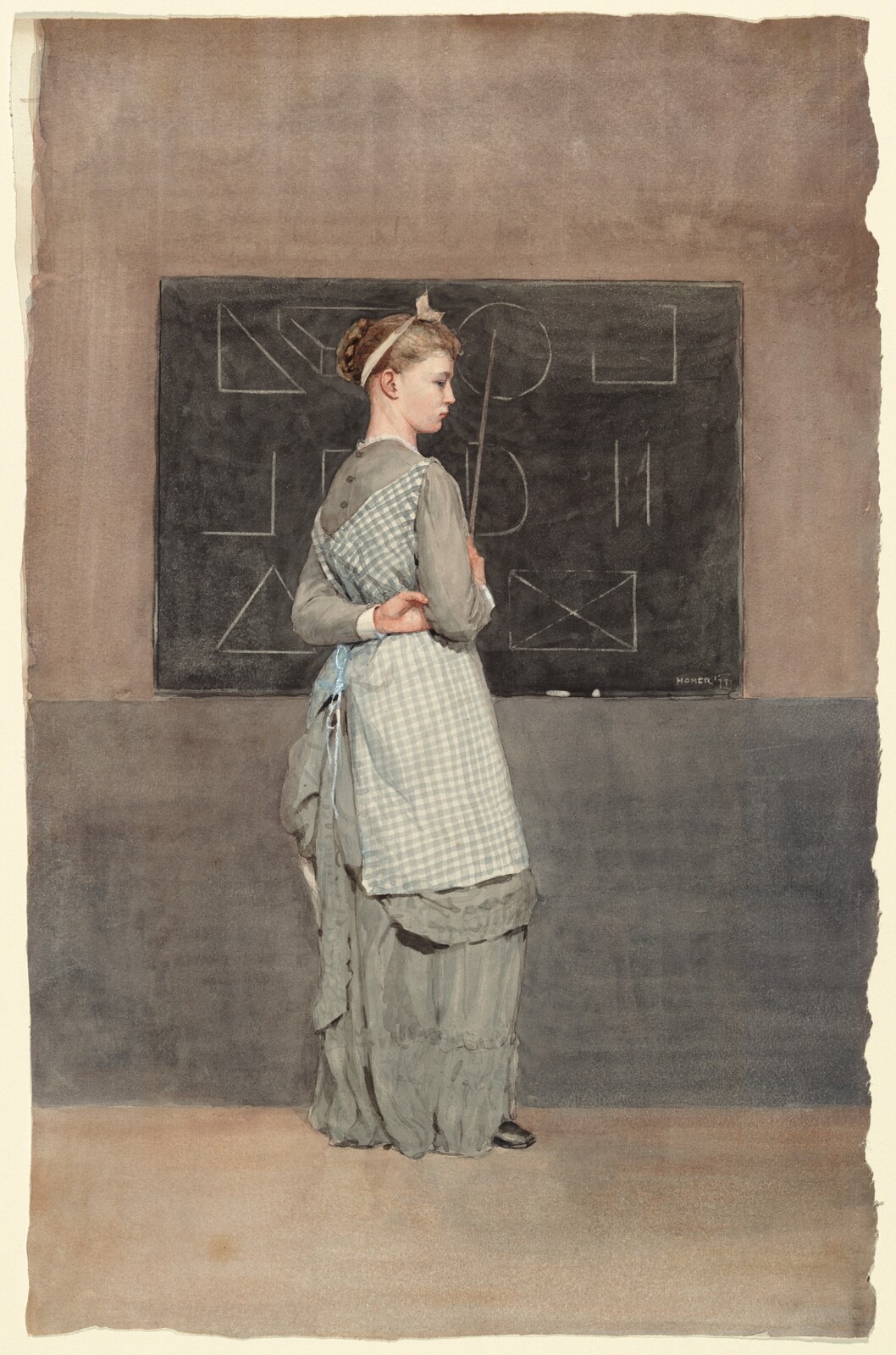
Watercolor of a woman holding a pointer in front of a blackboard marked with rows of geometric shapes.

Figure 1 · 1877

Blackboard

Look from the chalk shapes to the pointer and the figure beside them. A few simple marks become something people can discuss together. What would you draw to explain an idea from your own work or daily life, and what would still need words?

Winslow Homer · National Gallery of Art, Washington
Gift of Jo Ann and Julian Ganz, Jr., in Honor of the 50th Anniversary of the National Gallery of Art · 1990.60.1

View full size ↗Download image
Collection record and reuse rights

Display copies are resized and compressed. Source and license links apply to the image above.

Explore more museum and archive collections →

Education · The Blackboard

Show the development of an idea

Treat a board as a record that unfolds in time. Decide what must stay visible while new information is added.

Try this

Sketch three stages of a short explanation. Mark what is retained, erased or reorganized.

Reflect

Could someone reconstruct the reasoning from the final board alone?

Take it further · optional follow-up

Cover the middle stage of your explanation. Identify the missing step a learner would need, then revise the final board to retain that connection.

Compare with another activity · Software

The Commit: Explain a change to a future reader →

Prepared study prompt · not an editor-reviewed research article

Explore the perspectives

The eight prepared perspectives below are open to everyone. Sign in for expanded readings, a private notebook and collections.

Sign in for a deeper reading and notebook →

Historical

How did this evolve, and why has it endured?

Blackboards belong to the history of shared classroom surfaces, alongside slates, paper and later displays. Their use varies with teaching practice. A photograph records an arrangement, but not the discussion that developed around it.

Human

How do people actually experience this?

Writing in front of a group can reveal the sequence of an explanation. Learners see an idea develop rather than receiving only its final form. Legibility, pace and sightlines determine who can follow that process.

Imagine explaining a calculation on a shared board. Leave the original question visible while adding each step, and label a correction when you make one. Ask a reader to explain where the new step came from. The board can preserve a line of reasoning if the group can still see its earlier parts.

Cultural

How have different societies approached this?

A shared board can reinforce the teacher's authority or become a place where learners contribute. Who is invited to write matters. Consider how errors are handled when they become visible to the whole group.

Ethical

What responsibilities does this practice carry?

Public participation can support learning but also expose a learner to embarrassment. Offer ways to contribute without making confidence a prerequisite. Essential information should remain available to those unable to read the board during the lesson.

Debates

Where do thoughtful practitioners disagree?

Prepared slides offer consistency; a board permits adaptation and visible revision. Neither guarantees a clear explanation. Compare how each supports the particular sequence of reasoning being taught.

Material

What is it made of, and why does that matter?

Surface condition, chalk or marker quality, lighting and contrast affect readability. Erasing makes room while removing a record. Plan which ideas need to remain visible together and which should be preserved elsewhere.

Divide a sketch of a board into three areas: the question, the work in progress and a summary. Decide what can be erased and what must remain visible until the end. Compare this arrangement with a board filled wherever space happens to remain, then ask someone to locate the main conclusion.

Economic

How has commerce shaped this?

A simple board may be inexpensive to maintain, while digital systems add capabilities and support requirements. Compare the whole cost, including reliability and training. More features do not necessarily reduce teaching effort.

Future

Where might this be heading?

Digital shared surfaces can preserve work and support remote participation. They also need clear navigation and dependable access. The enduring design question is how a group can follow, question and revisit an emerging explanation.