Skip to content
Education

A topic from several perspectives

Apply this topic to your work →

The Lecture

Explore the lecture through the perspectives below. Compare their examples and tradeoffs, then connect what you learn to your own work.

Illustrated study

A room built for attention

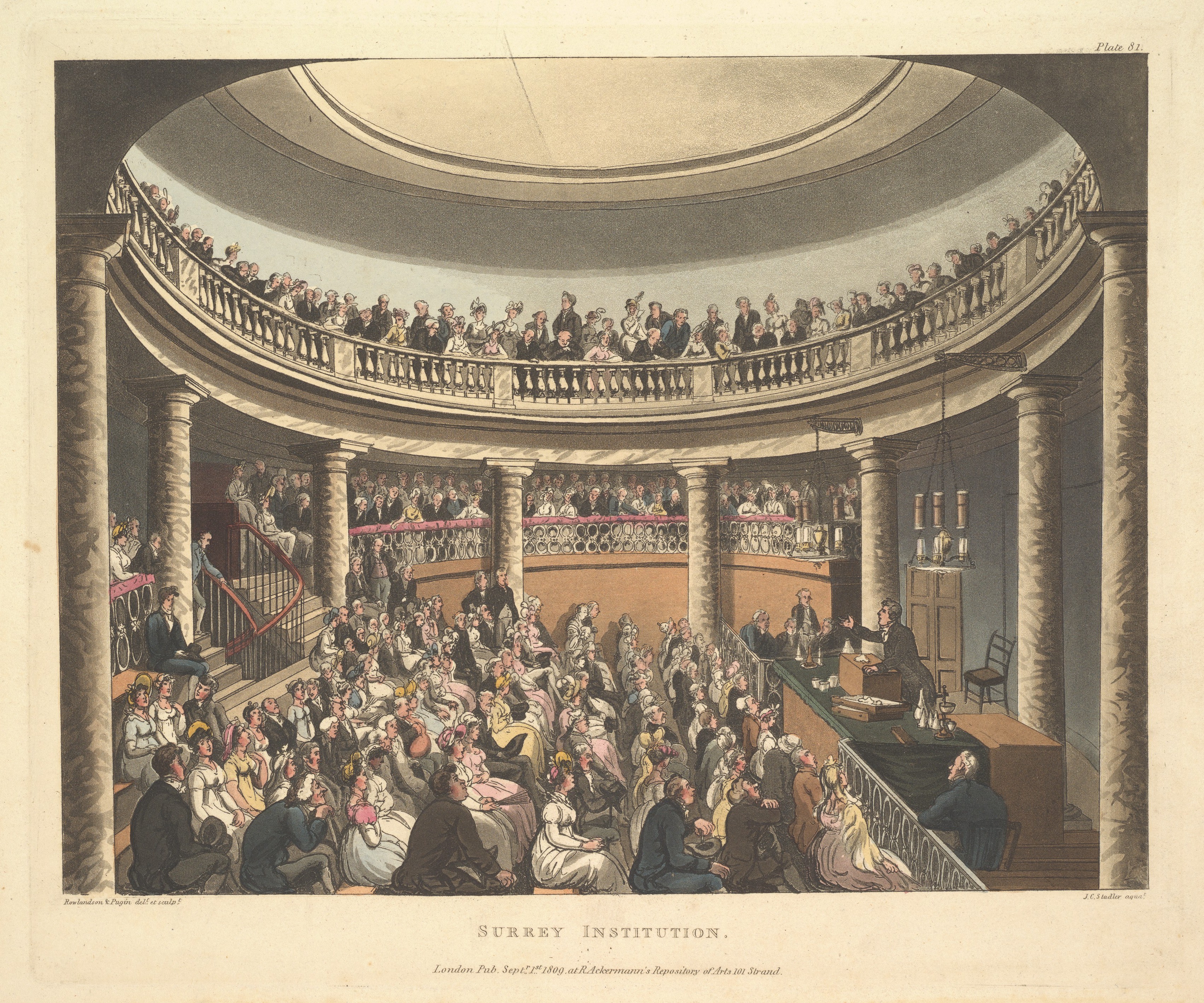
A hand-colored view published in 1809 shows a lecture hall with its audience in place.

Hand-colored etching of a crowded lecture hall, with a speaker at a raised desk under a gallery and rows of seated listeners filling the floor.

Figure 1 · September 1, 1809

Surrey Institution, plate 81 from "Microcosm of London"

Find the speaker, the platform and the rows that face it. The arrangement makes listening the main activity and leaves little room for anything else. Compare this with a room where you have learned something. Which parts of the setting do the work of holding attention, and which parts only make the group easier to count?

Thomas Rowlandson · The Metropolitan Museum of Art
Bequest of Phyllis Massar, 2011

View full size ↗Download image
Collection record and reuse rights

Display copies are resized and compressed. Source and license links apply to the image above.

Explore more museum and archive collections →

Education · The Lecture

Plan for a visible response

Choose a short explanation and define how you would learn whether it was understood. Attendance alone cannot answer that question.

Try this

Outline an opening example, one central idea and a question asking learners to apply it.

Reflect

What answer would make you change the explanation?

Take it further · optional follow-up

Draft two plausible learner responses to your application question. For each, plan a follow-up that reveals the reasoning behind the answer.

Compare with another activity · Education

The Mentor: Make a useful question →

Prepared study prompt · not an editor-reviewed research article

Explore the perspectives

The eight prepared perspectives below are open to everyone. Sign in for expanded readings, a private notebook and collections.

Sign in for a deeper reading and notebook →

Historical

How did this evolve, and why has it endured?

Lectures belong to a long history of teaching through spoken exposition. Their purposes vary across institutions and periods. Compare a particular lecture's audience, setting and available texts before treating the format as a single unchanging tradition.

Human

How do people actually experience this?

A listener must follow an explanation while deciding what to record and what to question. Pauses, examples and clear transitions can make that task more manageable. Ask what learners can do with the ideas afterward, not only whether they enjoyed the delivery.

Imagine a short explanation of how to read a floor plan. After introducing the symbols, pause and ask listeners to trace a route from the entrance to a room. Their routes give you something specific to discuss. A request to apply one idea can reveal questions that 'Does everyone understand?' leaves unanswered.

Cultural

How have different societies approached this?

Expectations about speaking, listening and interrupting differ between learning settings. Silence may indicate concentration, uncertainty or reluctance to challenge authority. A lecturer needs ways to discover understanding without relying on one visible behavior.

Ethical

What responsibilities does this practice carry?

A lecture allocates attention and authority. Consider whose work is credited, whose experience appears in examples and whether learners can access the material through suitable alternatives. Attendance alone does not show that access was meaningful.

Debates

Where do thoughtful practitioners disagree?

Extended explanation can establish a coherent argument; discussion and practice can expose misunderstandings. The useful question is how these activities serve the learning objective. A format should not be defended independently of what learners need to learn.

Material

What is it made of, and why does that matter?

Room acoustics, seating, projection and recording affect what can be heard and seen. Dense slides may compete with speech for attention. Inspect the experience from the back of the room and through any remote format.

Sketch a slide with a plan on one side and a short legend on the other. View it from the distance at which a listener would sit, then compare it with a version filled with explanatory text. Ask which details must be visible while the speaker talks and which belong in a separate handout.

Economic

How has commerce shaped this?

One speaker can address many people, but preparation, support and feedback still require time. A large audience does not make learning inexpensive in every respect. Account for the work needed before and after the presentation.

Future

Where might this be heading?

Recorded and live explanations can serve different purposes. Reusable recordings may free time for discussion, but they need maintenance and accessible presentation. Judge the arrangement by how learners use it rather than by the novelty of delivery.