Skip to content
Software

A topic from several perspectives

Apply this topic to your work →

The Loop

Explore the loop through the perspectives below. Compare their examples and tradeoffs, then connect what you learn to your own work.

Illustrated study

A sequence made visible

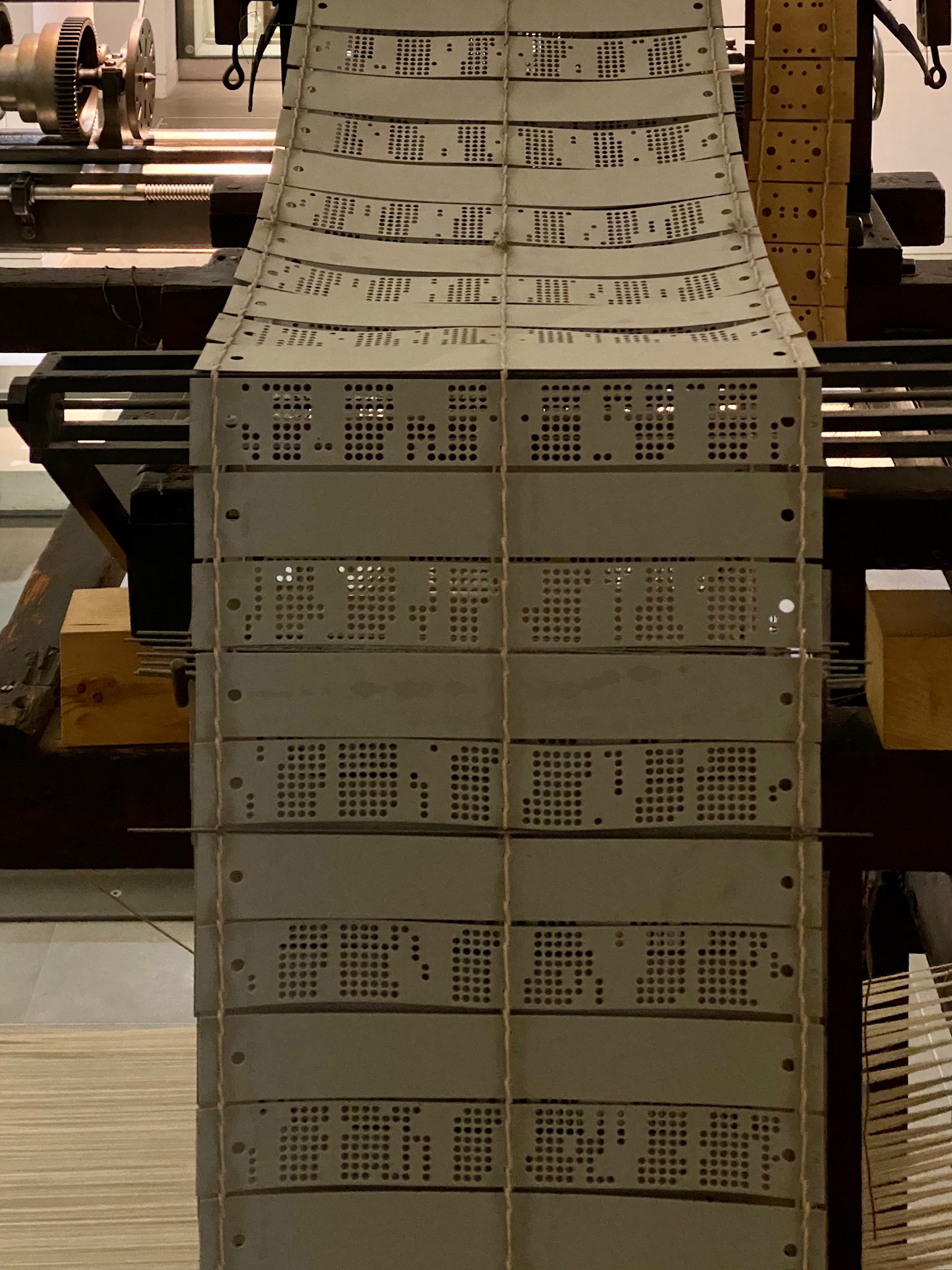
Linked Jacquard cards offer a material comparison for thinking about repeated instructions.

A linked chain of punched cards passing around a mechanism, with repeated rows of holes.

Figure 1 · 16 February 2020

Jacquard loom cards

Follow the connected cards and compare their hole patterns. A repeated operation and a repeated pattern are different things: what changes from one step to the next? Use the visible sequence as a comparison with a software loop, then ask what controls repetition and what would make it stop. The photograph does not reveal the machine's complete operating logic.

Robert-brook · Science Museum, London · photograph via Wikimedia Commons
Photograph by Robert-brook · CC0

View full size ↗Download image
Collection record and reuse rights

Display copies are resized and compressed. Source and license links apply to the image above.

Explore more museum and archive collections →

Software · The Loop

Trace repetition on paper

Choose a small fictional repeated task. Make its starting condition, repeated action and stopping condition explicit.

Try this

Trace zero, one and several repetitions in a table. Include a case where the expected stopping condition is never reached.

Reflect

What assumption determines whether the process ends?

Take it further · optional follow-up

Add an unexpected input to your paper trace. State whether the stopping rule still works and revise the rule in plain language before trying another trace.

Compare with another activity · Manufacturing

The Assembly Line: Trace a handoff →

Prepared study prompt · not an editor-reviewed research article

Explore the perspectives

The eight prepared perspectives below are open to everyone. Sign in for expanded readings, a private notebook and collections.

Sign in for a deeper reading and notebook →

Historical

How did this evolve, and why has it endured?

Repeated procedures connect programming to older practices of calculation and instruction. Compare a written algorithm with an executable loop: both specify repetition, but the machine requires explicit rules about continuation and change.

Technical

How does it actually work?

A loop repeats work according to a condition or a sequence of items. Trace one iteration at a time, recording what changes and what stops the repetition. Empty inputs and boundary values often reveal assumptions hidden by an ordinary example.

Imagine checking a list of four orders for missing delivery addresses. On each pass, inspect one order, record whether its address is present, then move to the next. The loop ends after the fourth order. Try an empty list and a list with one order: the same rule should still have a clear outcome.

Human

How do people actually experience this?

Repetition saves people from performing the same operation manually, but it can also repeat an error at speed. A useful interface lets someone understand progress and interrupt work when the result is wrong.

Suppose an automated reminder is sent twice to every person on a list. The repetition has worked, but the task has gone wrong. A person investigating needs to know which recipients were processed and whether restarting would contact them again. Progress information is useful only when it describes what actually happened.

Ethical

What responsibilities does this practice carry?

Repeated actions can affect many people before anyone notices a mistake. Consider whether a batch operation needs a preview, a limit or a way to reverse its effects. Responsibility includes what happens outside the programmer's immediate view.

Economic

How has commerce shaped this?

The cost of repetition depends on the work performed each time and how often it occurs. A small operation can become expensive when multiplied across a large collection. Measure the relevant workload before optimizing an isolated line.

Cultural

How have different societies approached this?

Programming communities develop conventions for expressing iteration clearly. A compact expression familiar to one team may be obscure to another. Readability depends partly on the knowledge shared by the people maintaining the code.

Debates

Where do thoughtful practitioners disagree?

An explicit loop can make intermediate steps visible; a higher-level operation can emphasize the intended transformation. Compare both using the same task, including how errors and early termination are handled.

Future

Where might this be heading?

Automation can expand the amount of repeated work a system undertakes. The enduring questions remain concrete: what changes, when does it stop, and who can see or correct the consequences?