Skip to content
← Learning guide

The Chart

← Back to study results
Other download formats

Activity 3 of 3

Describe before you explain

Practice separating what you can see from what you think it means.

Closing reflection: Which parts of your account are observations, and which still need evidence?

Illustrated study

Making a pattern visible

A historical statistical diagram connects observation, health and visual explanation.

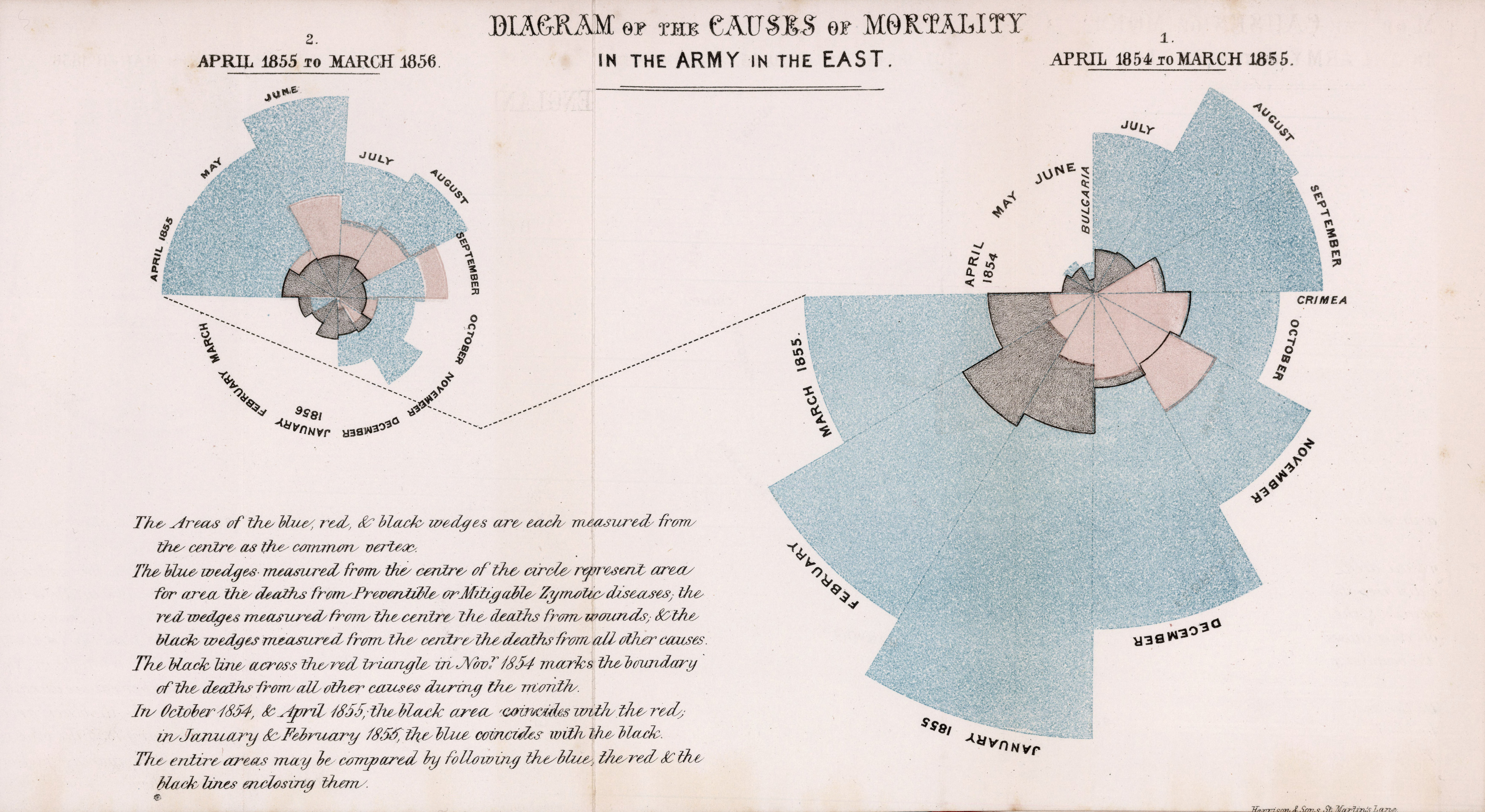
Two circular diagrams with monthly wedges in blue, red and black, comparing causes of mortality across two years, accompanied by a printed explanatory key.

Figure 1 · 1858

Diagram of the Causes of Mortality in the Army in the East

Begin with the key, then compare the two years. Each month occupies a wedge; the colored areas distinguish causes of death. Notice how much interpretation depends on the labels and explanation. This is a population-level historical diagram, rather than an individual patient chart.

Florence Nightingale · David Rumsey Map Collection · reproduction via Wikimedia Commons
Historical polar-area diagram

View full size ↗Download image
Collection record and reuse rights

Display copies are resized and compressed. Source and license links apply to the image above.

Explore more museum and archive collections →

Medicine · The Chart

Distinguish a record from an interpretation

Work with an invented record to see how dates, observations and interpretations can become confused. Use no real medical information.

Try this

Create three fictional entries and label the time, source and whether each is a report, observation or interpretation.

Reflect

What could a later reader mistakenly treat as established fact?

Take it further · optional follow-up

Give your invented entries to a reader without extra explanation. Ask which statements they interpret as observations, then revise ambiguous source labels.

Compare with another activity · Software

The Commit: Explain a change to a future reader →

This opens a separate activity. Use Back to return to your sequence.

Prepared study prompt · not an editor-reviewed research article