Skip to content
← Learning guide

The Stack

← Back to study results
Other download formats

Illustrated study

The order of retrieval matters

A box of punched-card programs makes order, grouping and retrieval tangible.

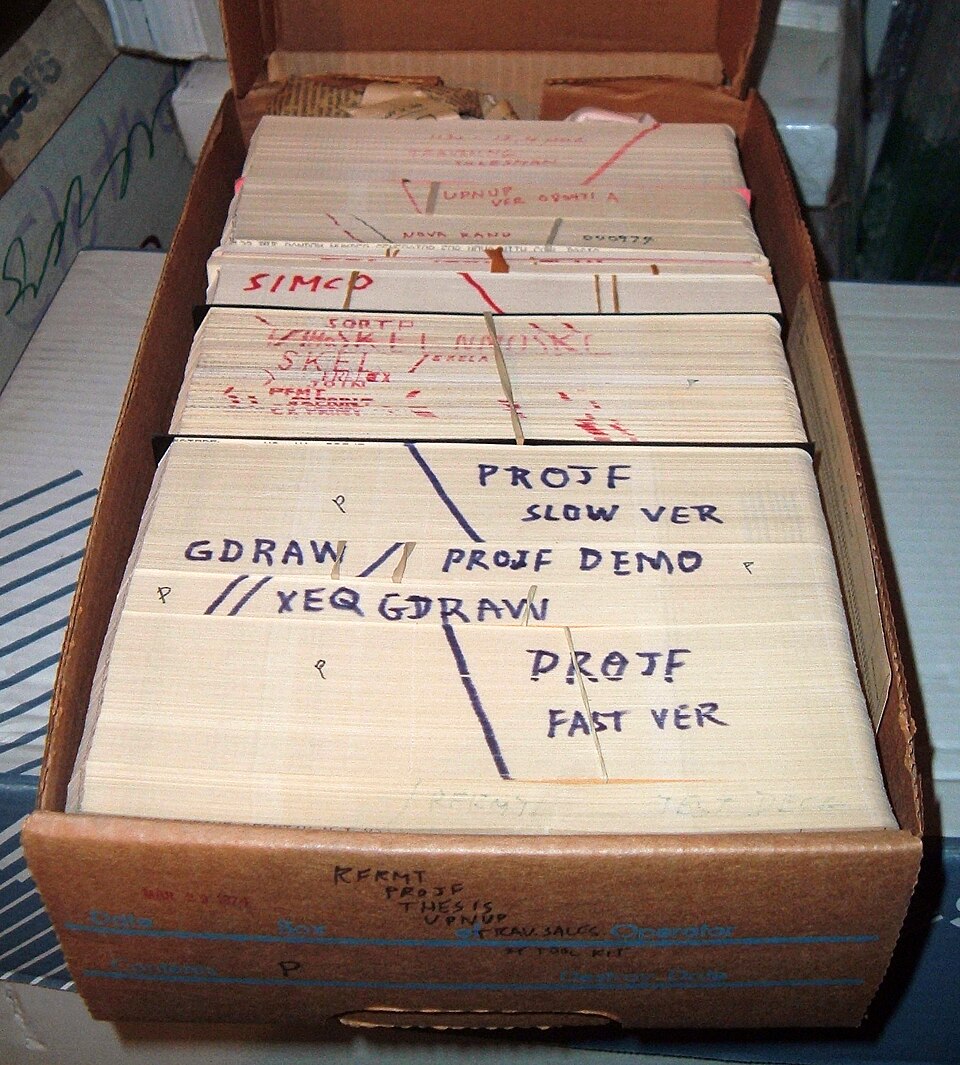
Several decks of punched cards packed upright in a cardboard box, with colored markings across their edges.

Figure 1 · 11 May 2006

Punched-card program decks

Notice how the edge markings help distinguish groups of cards. Imagine laying one deck flat and adding and removing cards only at the top: the last card added would be the first removed. That rule describes a stack. These historical program decks illustrate ordered material, not evidence that their programs used that data structure.

Arnold Reinhold · Photographer's collection · via Wikimedia Commons
Arnold Reinhold · lightened reproduction by Till.niermann · CC BY-SA 2.5 · 960-pixel reproduction

View full size ↗Download image
Collection record and reuse rights

Display copies are resized and compressed. Source and license links apply to the image above.

Explore more museum and archive collections →

Software · The Stack

Follow a dependency

Take a familiar digital action and list the layers you think it depends on. Mark each uncertain connection instead of presenting a guess as architecture.

Try this

Draw a small dependency map for a fictional app, then ask what happens when one layer is unavailable.

Reflect

Where should a failure become understandable to the user?

Take it further · optional follow-up

Choose one unavailable layer in your fictional map. Describe what the user would see and what a useful recovery message should explain.

Compare with another activity · Manufacturing

The Supply Chain: Follow an information gap →

Prepared study prompt · not an editor-reviewed research article